
BatchToken Lifecycle
Every BatchToken follows a defined lifecycle from mint to burn. Understanding this lifecycle is essential for building integrations, writing tests, and reasoning about collateral state at any point in time.
Full Lifecycle Diagram
Section titled “Full Lifecycle Diagram”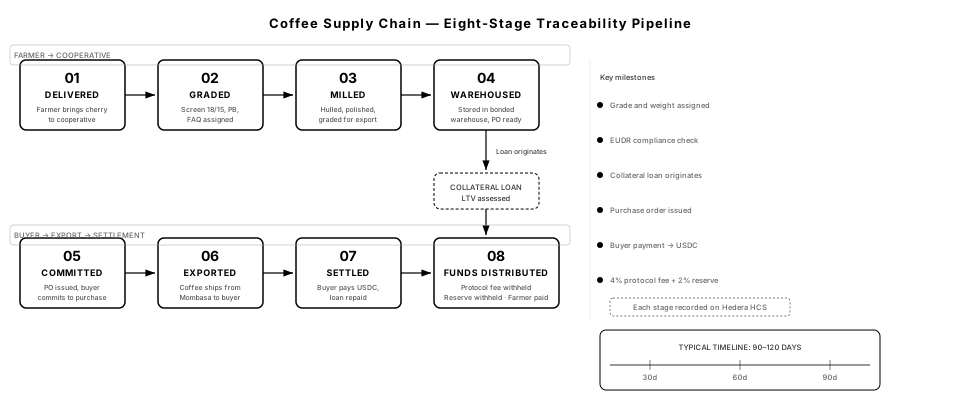
Collateral State at Each Stage
Section titled “Collateral State at Each Stage”| Stage | Has loan available? | LTV | Token transferable? |
|---|---|---|---|
| DELIVERED | Yes | 60% | Yes (if no active loan) |
| GRADED | Yes | 65% | Yes (if no active loan) |
| MILLED | Yes | 67% | Yes (if no active loan) |
| WAREHOUSED | Yes | 70% | Yes (if no active loan) |
| COMMITTED | Yes | 80% | No (PO locks transfer) |
| EXPORTED | No new loans | — | No (settlement in progress) |
| SETTLED | — | — | Burned |
Loan State Machine (Parallel to Stage Machine)
Section titled “Loan State Machine (Parallel to Stage Machine)”No loan: DELIVERED → GRADED → MILLED → WAREHOUSED → COMMITTED BatchToken transferable. Farmer receives coffee payment at DELIVERED.
With loan originated at DELIVERED: DELIVERED (loan active, token locked) → GRADED (LTV increases, loan can be topped up) → MILLED → WAREHOUSED → COMMITTED (LTV increases to 80%) → EXPORTED (auto-repayment triggered) → SETTLED (loan closed, CreditScore +50, token burned)
With forbearance: EXPORTED event delayed (harvest failure) → 90-day forbearance granted by multisig → If export occurs within 90 days: normal SETTLED flow → If no export after 90 days: credit loss reserve absorbs, MFI protectedWhat Cannot Happen
Section titled “What Cannot Happen”The contract architecture enforces these invariants:
- ❌ A BatchToken cannot go backward in stage (GRADED → DELIVERED is impossible)
- ❌ A locked BatchToken cannot be transferred or used as collateral for a second loan
- ❌ A token cannot be burned before SETTLED (burn requires VAULT_ROLE, only callable by LendingVault)
- ❌ A DDS cannot be generated for a token below GRADED stage
- ❌ Two PurchaseOrders cannot exist for the same BatchToken simultaneously
Testing the Lifecycle
Section titled “Testing the Lifecycle”describe('BatchToken full lifecycle', () => { it('should complete DELIVERED → SETTLED with auto-repayment', async () => { // 1. Register farmer await farmerRegistry.registerFarmer(farmer.address, 'UG-TEST-001', ...);
// 2. Mint batch const tokenId = await batchToken.mintBatch(coop.address, 'UG-TEST-001', ...);
// 3. Originate loan await lendingVault.originate(tokenId, { from: farmer.address }); expect(await batchToken.hasActiveLoan(tokenId)).to.be.true;
// 4. Advance through stages await traceLog.updateStage(tokenId, TraceStage.GRADED, evidenceCid); await traceLog.updateStage(tokenId, TraceStage.MILLED, evidenceCid); await traceLog.updateStage(tokenId, TraceStage.WAREHOUSED, evidenceCid);
// 5. Confirm PO await purchaseOrder.createPurchaseOrder(tokenId, 'Test Buyer', 500e6); await purchaseOrder.confirmPurchaseOrder(0);
// 6. Export — triggers auto-repayment await traceLog.updateStage(tokenId, TraceStage.EXPORTED, evidenceCid);
// 7. Assert settlement expect(await creditScore.getScore('UG-TEST-001')).to.equal(550); // 500 + 50 expect(await batchToken.exists(tokenId)).to.be.false; // burned });});